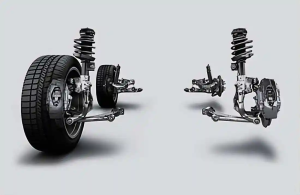
If your commute feels like a bounce-off-every-pothole festival, it’s time to check your shocks and struts. These suspension heroes turn jarring potholes into gentle landings—imagine riding on a plush couch instead of a trampoline.
Shocks vs. Struts—What’s the Difference?
- Shocks are standalone dampers filled with hydraulic fluid; they tamp down spring action after you hit a bump.
- Struts combine that damping action with a structural element—coil spring and mount—so they support part of your car’s weight too.
Warning Signs Your Suspension Needs Love
- Bouncy Ride
Car feels like it’s auditioning for a gymnastics team—major rebound after every dip. - Nose Dive Under Braking
Slam the brakes and watch the front end take a bow—uncomfortable and unsafe. - Floaty Steering
You’re wrestling the wheel just to stay straight—it shouldn’t feel like steering a sailboat. - Uneven Tire Wear
“Feathered” or scalloped tread indicates suspension allowing tires to bounce unevenly.
Expected Lifespan
Under typical city driving, shocks and struts last 50,000–70,000 miles. If you’re tackling backroads or hauling heavy loads, budget on closer to 30,000–40,000 miles.
OEM vs. Performance Upgrades
- OEM-Style
- Pros: Cost-effective, comfort-tuned
- Cons: No sport-handling benefits
- Performance Dampers (Bilstein, KYB, Koni)
- Pros: Sharper handling, better cornering control
- Cons: Stiffer ride, higher price tag
DIY or Go Pro?
Simple shock replacements can be DIY-friendly, but strut swaps require a spring compressor and precision torqueing. One wrong move with a compressed spring and you’ll have more than a banged knuckle—trust a shop if you’re not fully confident.
Pro Tip
Give your suspension a quick once-over every oil change: look for oil leaks on shock bodies, dents or rust on struts, and listen for any clunks when rocking each corner of the car.
Treat your shocks and struts well, and rough roads turn into smooth sails. Ignore them, and you’ll feel every crack in the pavement—plus pay extra in tire and alignment costs.