High water temperature is a fault that occurs frequently in summer. There are many reasons for high water temperature, which are not easy to diagnose. Usually, maintenance personnel will start with several parts that are prone to problems, such as water temperature sensors, thermostats, radiator fans, etc. When these parts are removed, maintenance personnel will suspect the radiator.
The function of the radiator is to heat the coolant to ensure that the engine runs at a normal operating temperature and avoid overheating. It is a very durable automotive part, so it will be placed at the back of the team for inspection.

So how do maintenance personnel determine whether a radiator is good or bad?
1. Appearance inspection
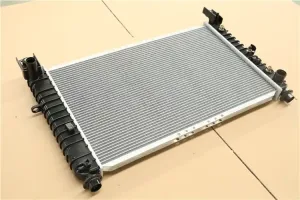
The first thing to check is the appearance, observe whether the radiator core is seriously deformed or damaged, and whether the surface of the radiator core is seriously dirty. As you know, a radiator that is too dirty will lead to poor heat dissipation and cause high water temperature problems.

2. Leakage Check
Check the connection between the radiator core and the upper and lower water pipes for signs of leakage. The coolant will leave obvious traces after evaporation. Also check the clamping of the upper and lower water pipes of the radiator to ensure that they are firmly clamped. Loose clamps are often the main cause of air leakage here.
Alternatively, if the leak cannot be detected by observation alone, it can be checked by pressure testing, which requires the use of a pressure tester. Pressure testing can help identify leaks that are difficult to detect, either by pressurizing the radiator to allow coolant to escape from the leak, or by holding a pressure test to see if the radiator can hold pressure.

3. Cycle status check
A blockage in the radiator core will result in a blockage of coolant flow and can also cause the engine to overheat. Usually the blockage is caused by scaling and corrosion of the radiator core.
For models with a radiator cap, remove the radiator cap and start the engine to warm up. When the engine reaches its operating temperature, that is, when the thermostat opens, you will see coolant flowing through the opening. If you do not see coolant flowing, it may be a blocked radiator, a faulty thermostat, or a faulty pump.

For models without radiator caps, we can judge the circulation of coolant by the temperature of the upper and lower water pipes of the radiator. When the engine reaches normal operating temperature, if the temperature difference between the upper and lower pipes is large, it means that the coolant circulation is poor, and there may also be radiator blockage, thermostat failure or pump failure.
In addition, we can also use an infrared thermometer to test the temperature of various parts of the radiator core after the engine reaches normal operating temperature. If there is a large temperature difference in some parts, it also means that the radiator may be blocked.

Conclusion
The radiator is one of the most important components in the cooling system. It consists of the radiator core and the coolant tank as well as various necessary connections and firmware. The radiator core is usually made of aluminum, while the coolant tank is made of aluminum or glass fiber reinforced polyamide.
Radiator failures are mainly divided into blockage and leakage. Blockage will directly cause the problem of high engine water temperature and cause engine overheating; leakage will lead to insufficient coolant, and in severe cases, it will also cause engine overheating, and overheating will cause serious damage to the engine.